Measure what your customers feel
We help CPG companies predict human sensory perception from lab measurements -- reducing reliance on costly consumer panels while maintaining scientific rigor. We design tests, build custom instruments, and deliver statistical models that connect lab data to real human experience.
Predicting human perception from lab data
Human sensory panels are the gold standard -- but they are expensive, slow, and impractical for routine testing. We build the statistical bridge between lab instruments and human perception, so you can reserve panels for final validation.
Test design
We design emulative and tribo-rheological protocols calibrated to the sensory attributes your team cares about -- mouthfeel, spreadability, stringiness, shape retention, and more.
Custom instrument development
When no existing instrument captures what you need, we build one. Our devices are designed around specific sensory hypotheses, not general-purpose measurement.
Statistical modeling
We build regression and machine learning models that predict panel scores from instrument data -- validated against your existing sensory data or alongside a calibration panel study.
Panel cost reduction
Once predictive models are established, routine reformulation checks can be run entirely in the lab -- reserving expensive consumer panels for final validation only.
We interpret data from instruments you already have
If your lab already runs any of the following, we can build predictive models from your existing data -- no new equipment required to get started.
Viscometer
Flow resistance and apparent viscosity at defined shear rates.
e.g. Brookfield DV seriesRheometer
Full flow curve -- viscosity, viscoelasticity, yield stress, thixotropy.
e.g. TA Instruments DHR, Anton Paar MCRTribometer
Friction and lubrication -- closely linked to mouthfeel and skinfeel.
e.g. Mini-Traction MachineTexture analyzer
Force-displacement of solids and semi-solids. The closest standard emulative tool.
e.g. Stable Micro Systems TA.XTCustom devices we have built
We design and build bespoke emulative instruments to your brief -- each one starts with your product, your consumer, and the perception you want to predict.
Spreading tribometer
Replicates the physical act of spreading a paste or emulsion, measuring friction and lubrication under conditions that closely mirror finger or applicator contact.
Stringiness meter
Emulates the pull-away motion when a product is stretched or separated -- quantifying stringiness and cohesive stretch in sauces, cheeses, gels, and adhesives.
Shape retention meter
Measures the structural integrity of extruded or deposited products as consumers see them -- toothpaste on a brush, cream from a tube, gel from a nozzle.
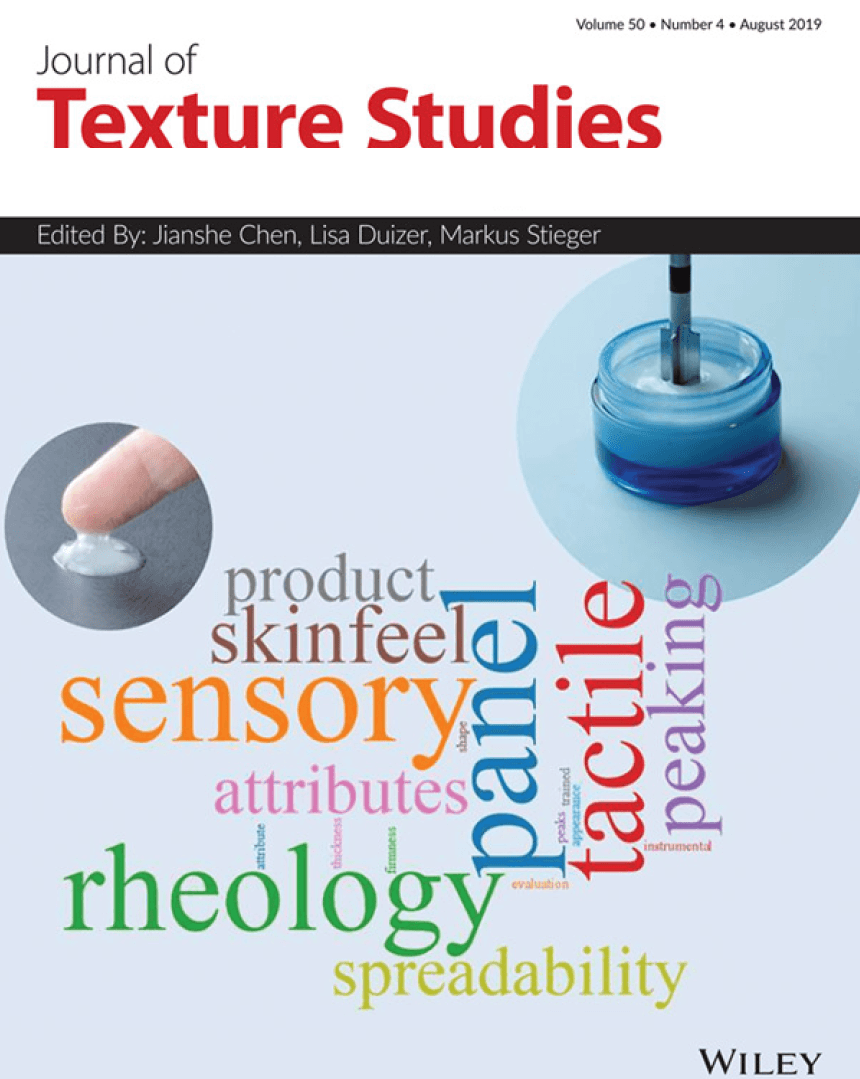 Journal of Texture Studies, Vol. 50, No. 4
Our methods are published in leading journals. Statistical relationships between lab measurements and human sensory scores -- validated across oral care, personal care, household, and food categories.
- Sunscreen sensory attribute prediction via textural, rheological and tribological testsInt. J. Cosmetic Science, 2026
- Prediction of tactile sensory attributes of facial moisturizers by rheology and tribologyBiotribology, 2021
- Psychophysical and rheological investigation of toothpaste tube squeezabilityJ. Texture Studies, 2024
Ready to measure what matters?
Bring one application: sunscreen spreadability, toothpaste squeezability, lotion after-feel, food mouthfeel, package dispensing, or another sensory attribute your panel can describe but your instruments cannot yet quantify.
Book a 30-min discovery call